
Curriculum principles
CurriculumSeven principles
A curriculum built on seven principles
This curriculum prepares academic language proficiency (CALP) through English, and grows, together with English, the intelligence and competence that underlie it — ‘English + intelligence + competence’. The intelligence and competence grown at one stage support learning at the next.
“Pangram Tier 1·2·3 Curriculum Overview”, preface, October 2026
- A child perceives sounds and expressions precisely and reproduces them, discovers the relations and meanings inside them, and applies what she found to new language situations. We call this thinking ability — perceiving, imitating, inferring, applying — ‘intelligence’, and the power to complete real learning tasks with it ‘competence’. The intelligence that begins in Tier 1 as perceiving, imitating, inferring and applying expands in Tiers 2·3 into structuring, explaining and narrating.
- The research cited beside each principle was consulted to explain it; it does not validate the effectiveness of this curriculum. Its composition and goals are curricular design.
Competence reached is the standard
The goal is the ability to acquire language, not the amount taught; movement between Tiers is decided by competence reached, not by time.
Mastery-learning meta-analysis (Kulik, Kulik & Bangert-Drowns, 1990)
Decoding and understanding, integrated
The sound–letter relation (SoundTree Core) and the acquisition of meaning (OneBite 600) are grown together and integrated on real text in PYP Basic.
Simple View of Reading (Gough & Tunmer, 1986) · reading and spelling as two sides of a coin (Ehri, 2000)
Multi-sensory acquisition
Sound, image, movement, letter and meaning are connected and learned within one experience.
Dual coding theory (Clark & Paivio, 1991)
Familiarity first, analysis later
Structure is handled consciously only after enough repetition has made sentences and stories familiar — from OneBite 600’s recitation to FluenTree’s multi-sensory recitation, then to structuring in PYP and ConnecTree.
Frequency effects and pattern learning (Ellis, 2002)
Retrieval at the center of review
Instead of looking and listening again, the child recalls from a cue. Vocapedia’s retrieval, PYP’s speech cards and blank-page summaries, ConnecTree’s cue cards are the devices.
Opportunities for retrieval (Barcroft, 2007) · the testing effect (Roediger & Karpicke, 2006)
Structuring on top of recitation
With the book already recited, its content is structured by criteria of classification, comparison and connection, and the whole is summarized without the book.
Microstructure and macrostructure (Kintsch & van Dijk, 1978)
Toward academic language
On the conversational fluency and basic literacy of Tiers 1·2, Tier 3 adds structuring, explaining and narrating to lay the foundation of academic language.
BICS and CALP (Cummins, 2008)
Tier 1
The basis of conversational fluency and discrete language skills
SoundTree Core · OneBite 600 · PYP Basic
Connects sound, letter and meaning within the context of images, movement and stories.
Tier 2
Extended conversational fluency; acquisition and retrieval of sentences and stories; structuring of nonfiction
FluenTree · PYP Level 1 · Vocapedia 1000 · Listening Wise
Acquires stories and sentences multi-sensorially, retrieves them when needed, and structures and summarizes nonfiction.
Tier 3
The foundation of academic language proficiency
ConnecTree · PYP Level 2 · Vocapedia 2000 · Listening Wise 3·4
Organizes what was learned within structure and relations, explains and narrates with evidence, and summarizes a book’s content in structure without the book.
Skills & subjects
Interdisciplinary Design — cognitive abilities on four axes
Lay each subject’s focal cognitive abilities on the four axes of Speaking, Listening, Reading and Writing and the design of the curriculum becomes visible: the ability built in one subject is the raw material of the next.
Reading
SoundTree Core
Inductive · Deductive Reasoning
FluenTree
Automaticity · Sequential Recall · Visual-Spatial Memory
ConnecTree
Structuring · Comprehension Monitoring · Long-Term Memory
IRP
Analyzing · Deep Insight · Multiple Perspectives · Interdisciplinary Connections
Speaking
OneBite 600
Visual Processing · Working Memory · Sequential Thinking
PYP Basic
Contextual Understanding · Remembering · Memory Recall
PYP Level 1
Organizing · Structuring · Remembering · Memory Recall
PYP Level 2
Structuring · Making Questions · Summarizing
PYP Level 3
Conceptualization · Logical Reasoning · Organizing & Structuring · Problem-Solving
Listening
Listening Wise 1–4
Auditory Processing · Language Processing · Immediate Recall
Vocapedia 1000 · 2000
Visual Processing · Language Processing · Rapid Retrieval
Writing
Make It Complete
Perfecting — mastery writing for PYP and Vocapedia
Habitus Level 3·4
Visual Memory · Selective Attention · Rapid Comparative Processing · Cognitive Structuring
Habitus Level 5·6
Critical Thinking · Conceptual Understanding · Meta-cognition
Habitus Level 7
Critical Thinking · Conceptual Understanding · Creative Thinking
Habitus Grammar
Analytical Thinking · Syntactic Processing · Structural Memory
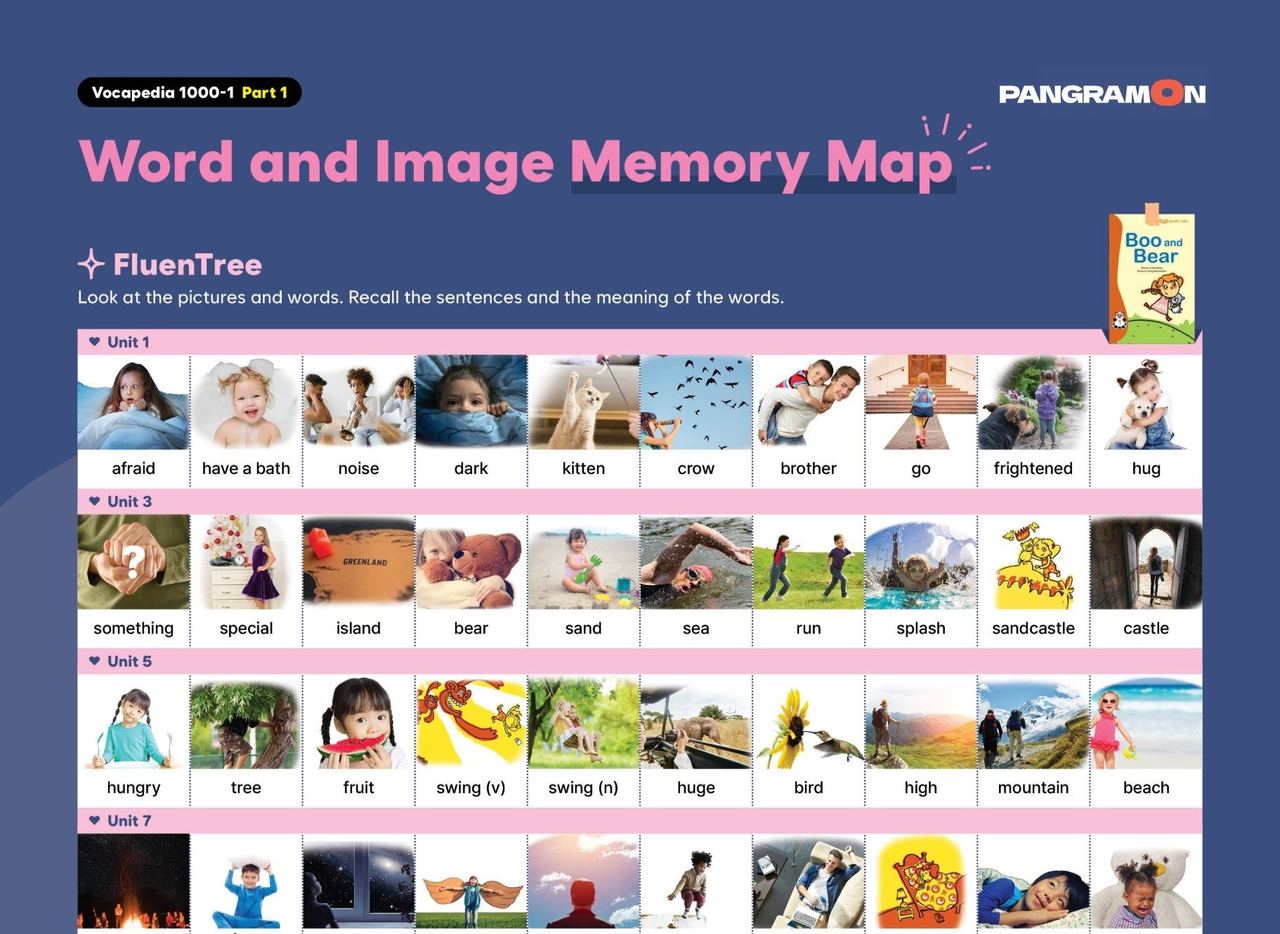
Odd units take their words from FluenTree storybooks, even units from PYP — the most direct evidence that the subjects are designed to cross over.
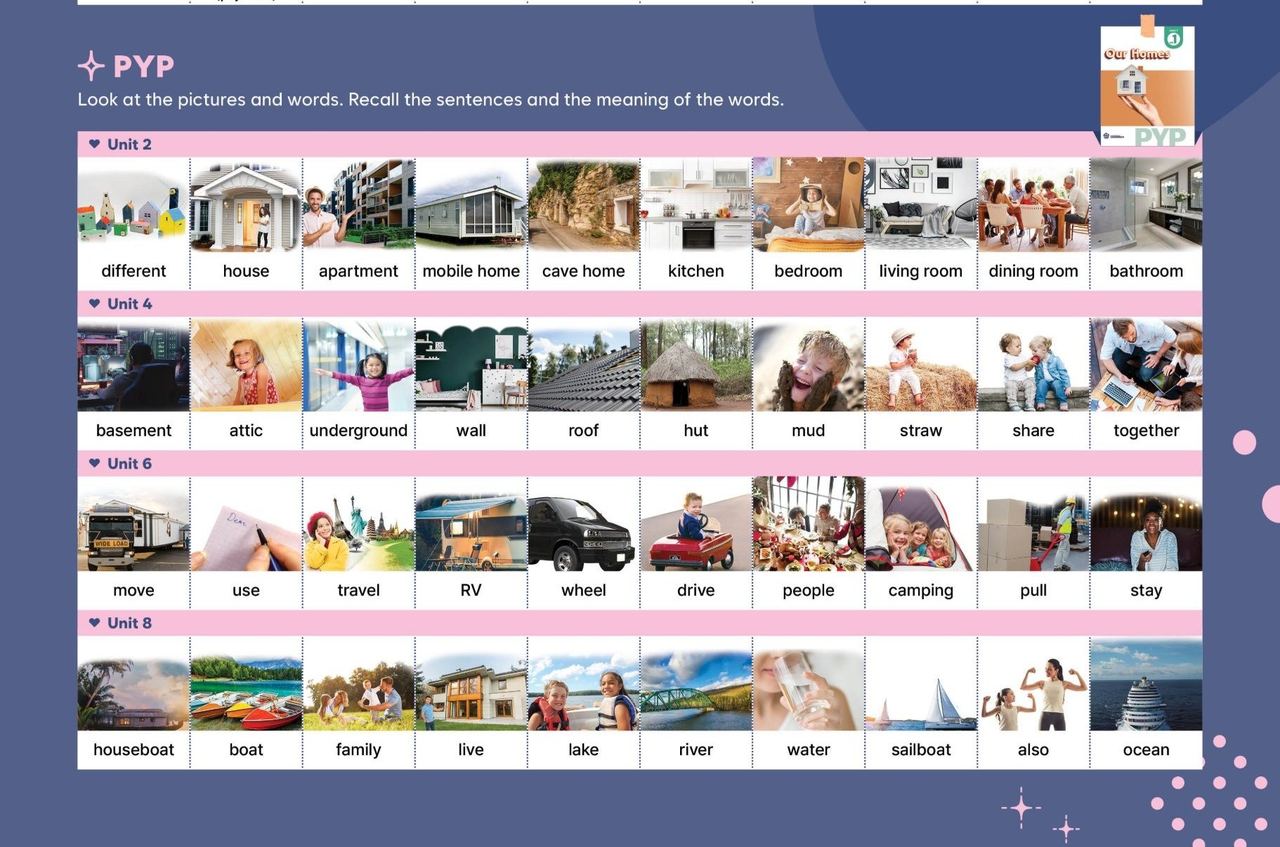
The lower half of the same poster: words met in PYP Level 1 “Our Homes”, recalled from photo cues.
Philosophy & evidence
Being good at English takes a good mind — so we grow both
In PangramOn’s view, teaching English alone flattens the learning curve quickly, while growing thinking skills with it makes the curve steeper over time. Every program in the three Tiers rests on seven design principles.
Sound, image, movement, letter and meaning are connected within one experience — with reference to dual coding theory, in which verbal and non-verbal representations support memory and retrieval.
Structure is handled consciously only after enough repetition has made sentences and stories familiar: from OneBite 600’s recitation to FluenTree’s multi-sensory recitation, then to structuring in PYP and ConnecTree.
On the conversational fluency and basic literacy of Tiers 1·2, Tier 3 adds structuring, explaining and narrating to lay the foundation of academic language (CALP).
The child who memorized and the child who understood
A child who memorized the rules forgets them quickly and feels wrong at every exception. A child who grasped the principle reads a word she has never seen — and gains confidence. Phonics is discovery, not memorization.
Every learning journey starts with a conversation
Contact us to learn about the curriculum and a campus near you.