
Learning & growth
Every subject moves to the same rhythm
Show the month’s flow first; reduce the cues until the child can do it alone; let her summarize and judge with her own hands; then show it at the end of the month. That is why the classroom posters of six subjects share one structure.
Learning method
Teaching + Coaching + Perfecting
English cannot be completed by teaching alone. So that deliberate practice beyond the comfort zone actually happens, we built a system in which the learner sets goals and reaches them — PangramOn’s gifted-English learning system.
Teaching
Teaching
Day 1 — new content with a native-speaking teacher. Classroom lessons built on head-office teaching materials (Learning Box).
→ PerfectingCoaching
Coaching
Day 2 — a professional learning manager guides the child to apply and extend what was taught (LINK 0·1·2). Entry checks and monthly and quarterly subject tests are part of LINK.
→ PerfectingPerfecting
Perfecting
Every day — the child reviews and practices on her own until it is hers. Practice, and practice again: feeling the progress makes English more fun (LINK_MyGrow).
“Perfecting Everyday.” One subject’s learning unit repeats as teaching → perfecting, coaching → perfecting. What was learned is retrieved that evening; what was applied is retrieved again the next.
Standardized teaching materials
Yearly, monthly and daily lesson plans with detailed teacher’s guides. The same quality of lesson at every campus.
Coaching and confirmation
LINK 0 coaches what was taught; LINK 1·2 coach the vocabulary and grammar e-learning. ★ subjects are confirmed with a link test once completed.
10–15 minutes of internalization a day
Twenty times a month. Reading aloud and recording is the main activity. The diary puts the child in charge of homework; the online bookshelf lets her look back at her own record.
Monthly Progress Report
Curriculum Details · Cognitive Assessment · Achievement Evaluation, on a four-point scale: 4 Excellent / 3 Meeting expectations / 2 Showing progress / 1 Needs encouragement. Sent home every month.
Monthly Assessment
Reading Check, Dictation, Speech Day, Memorization Test — every subject has its moment to show on day 20.
OKR Posters
Learning Flow shows the month first; Self Evaluation and Self Summary let the child judge and summarize with her own hands.
Learn and apply on campus, make it yours at home
A subject consists of two or three teaching sessions a week (Class), one or two coaching sessions (Learning Boat LINK), and MyGrow every day. Timetables vary by Tier and campus; each campus gives the exact times.
Class
Classroom lessons with a native-speaking teacher, run on head-office materials and yearly/monthly/daily lesson plans. Core 1 (SoundTree → FluenTree → ConnecTree) three times a week, Core 2 (PYP) twice.
LINK 0 — learning coaching
Learning Boat
Coaching linked to the teaching. With the learning manager the child retrieves and applies what was taught. LINK 0-1 (Core 1) twice a week, LINK 0-2 (Core 2) once or twice. ★ subjects take a link test when completed.
LINK 1 · 2 — vocabulary and grammar e-learning coaching
The e-learning of OneBite 600 (Tier 1), and of Vocapedia 1000·2000 and Listening Wise (Tiers 2·3), is bound to one coaching session a week.
MyGrow — 10–15 minutes of perfecting
Home
Twenty times a month. Read aloud and record what was learned that day. The diary puts the child in charge of homework; the online bookshelf lets her look back at her own record.
Week & month
Day 1 to Day 5 — a lesson in which the teacher does not read first
The weekly learning flow of SoundTree Core 1. Every subject’s week shares this skeleton: learn something new → review → read alone → read like a native speaker and dictate → confirm against the clock.
- Day 1
Discover and connect
Discover and distinguish phonemes · connect sounds and letters · pronounce like native speakers · blend and segment phonemes to read words.
- Day 2
Read it twenty times
Review · read the Let’s Practice pages 20 times independently with the teacher coaching · listen and dictate the words · memorize sight words and meaningful vocabulary.
- Day 3
Read alone, for the first time
Review Let’s Practice 5 times · read the Phonics Reader 5 times independently — a reader written only with this week’s sounds, read by the child first · review sight words.
- Day 4
Like a native speaker, then dictate
Review 5 times · the reader 5 times · listen and dictate Let’s Practice and the reader · read the reader like a native speaker.
- Day 5
Against the clock
Read the reader 5 times within a set time · listen and dictate · check sight-word memorization · (week 4) evaluate the month with the Monthly Reading Check.
Perfecting Everyday — one subject’s learning unit
Day 1 · Teaching → Perfecting
Learn something new from the native-speaking teacher → review and practice it on your own until it is yours.
Day 2 · Coaching → Perfecting
Apply and extend what you learned with the learning manager’s guidance → practice, and practice again — feeling the progress makes English more fun.
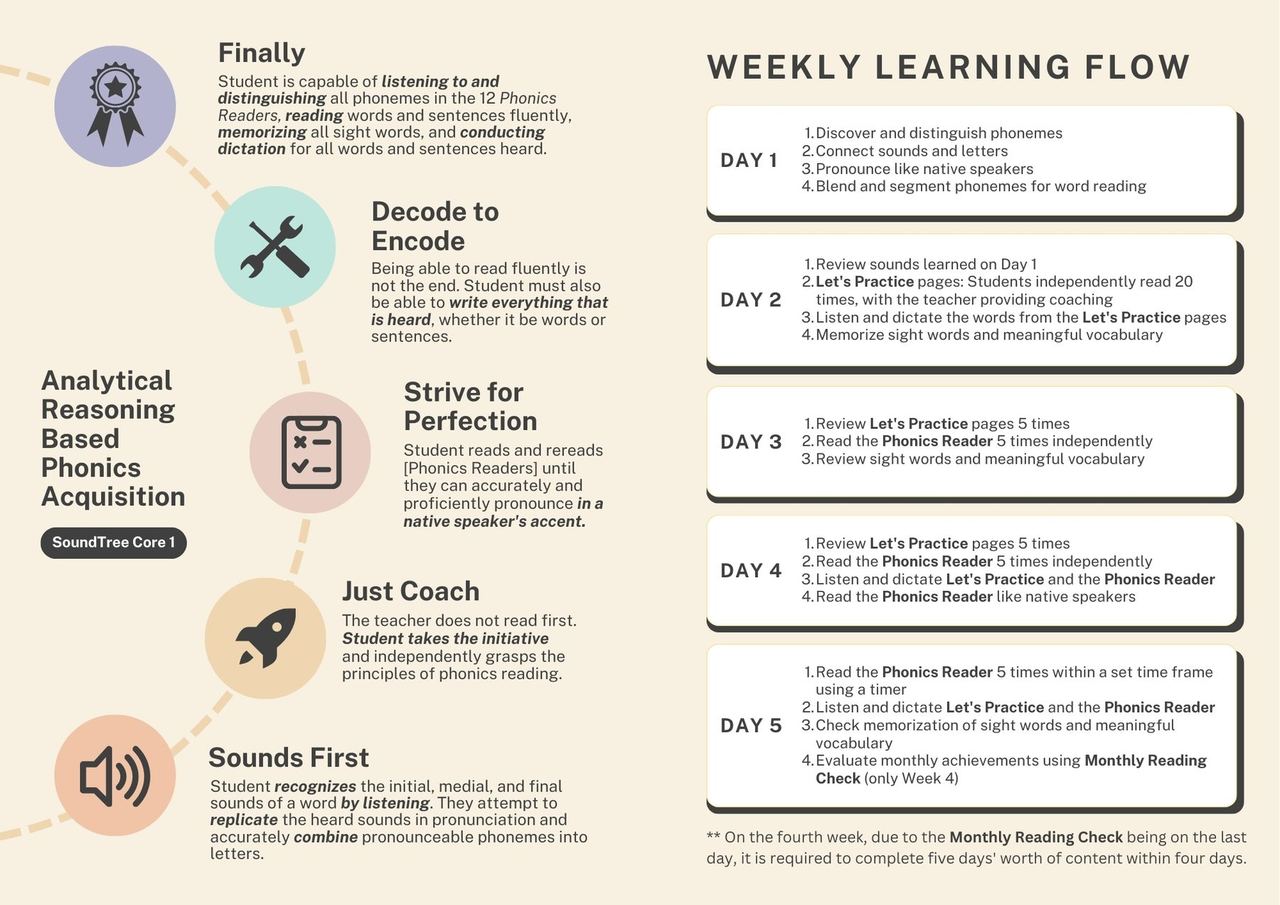
“Just Coach — The teacher does not read first. Student takes the initiative and independently grasps the principles of phonics reading.”
Twenty days — learn, reduce the cues, show it
Every subject shows the month’s flow to the child on day one (an advance organizer): see the big picture, understand the connections, plan systematically. Then the cues are reduced — pictures only → no pictures; sentence frames → a blank structure map.
Days 1–12 · Learn and practice
PYP Level 1 — Chapters 1·2·3, four days each: Pre-Reading → Vocabulary → Reading → 20 Questions → Speaking Set. FluenTree — five parts, three days each: listen and understand without text, echo like the native speaker, Dictation A·B·C, recite from pictures alone. OneBite 600 — Word Play 1·2 and the first story.
Days 13–19 · Fewer cues, more ownership
PYP — read the whole book repeatedly and memorize it structurally, answer the 20 questions proficiently, summarize with Speech Cards 1·2·3, recite the whole from the Story Structure Map, then write and rehearse the My Speech script. FluenTree — parts accumulated, Parts 1–4 in one go, then the whole with no pictures and no text. OneBite — the second story and Word Play 3·4.
Day 20 · Show it
Speech Day · Monthly Reading Check · Memorization Test · Day 20 Poster Activity (ConnecTree). A completed subject is confirmed with a LINK test (★), and the month’s Monthly Progress Report goes home.
“Listen and repeat the entire story every day. From Day 8, practice speaking by recalling and expressing the entire story by only looking at the pictures. Starting from the 13th day, practice presenting the story in a public speaking manner without relying on the images.” — the instructions on the PYP Basic Learning Flow poster
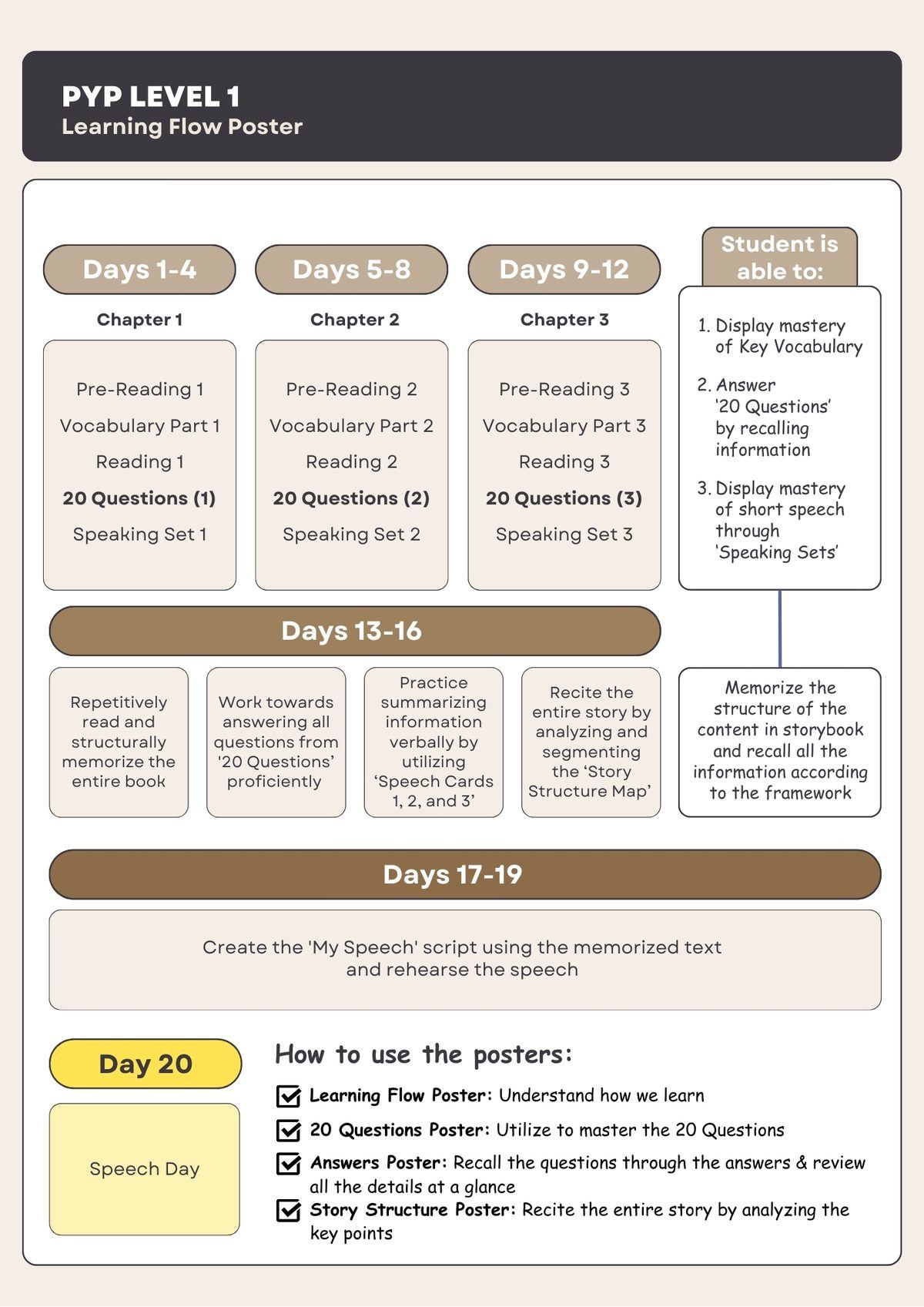
Days 1–4 Chapter 1 · 5–8 Chapter 2 · 9–12 Chapter 3 · 13–16 memorizing and structuring · 17–19 My Speech · Day 20 Speech Day.
Learning Flow Poster — PYP Level 1
The 20-day flow is shown to the child on day one. Per chapter: Pre-Reading → Vocabulary → Reading → 20 Questions → Speaking Set.
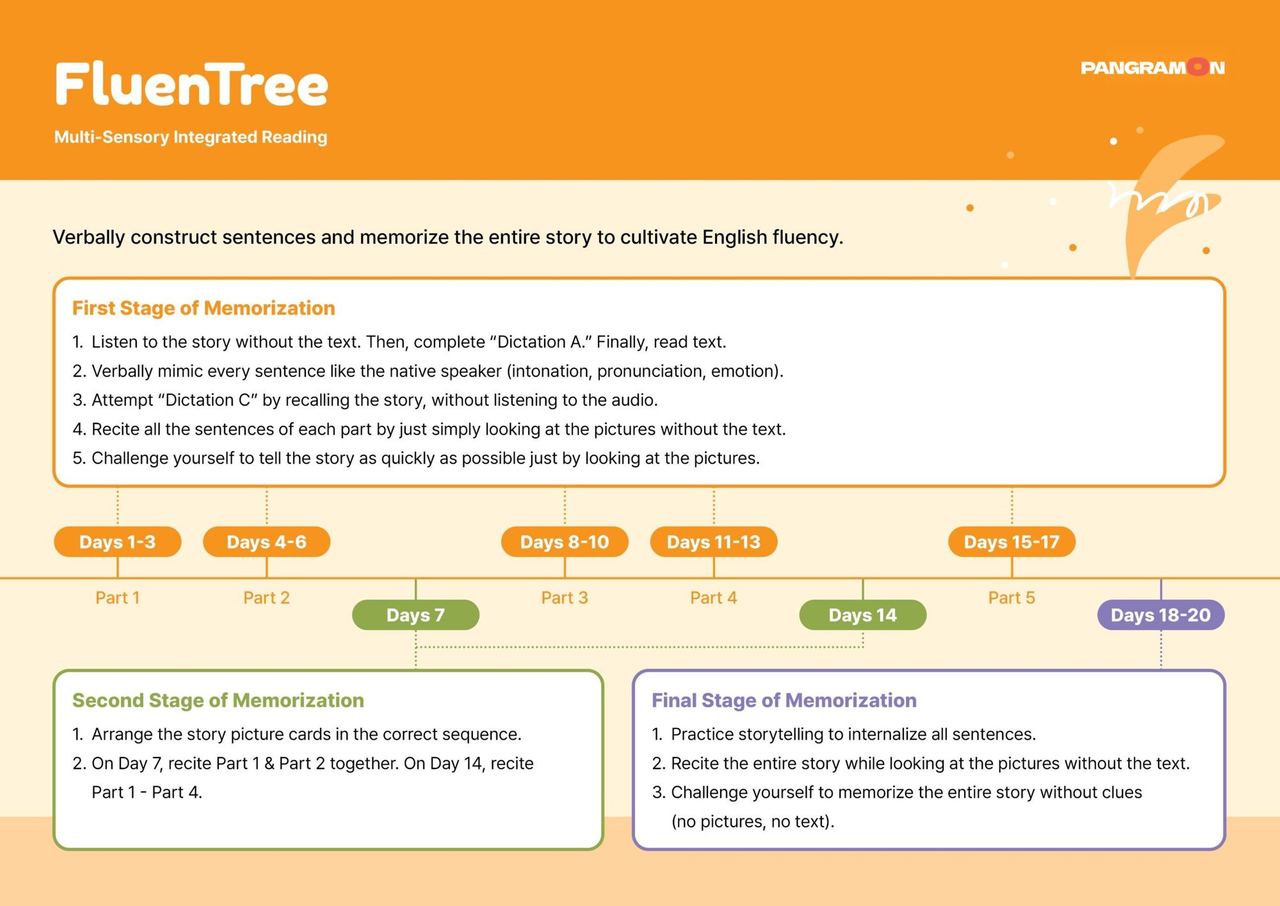
First Stage (by part) → Second Stage (Day 7 Parts 1&2, Day 14 Parts 1–4) → Final Stage (Days 18–20, the whole, without cues).
Five parts told from pictures alone (stage 1) → parts recited cumulatively (stage 2) → the whole story with no pictures and no text (stage 3).
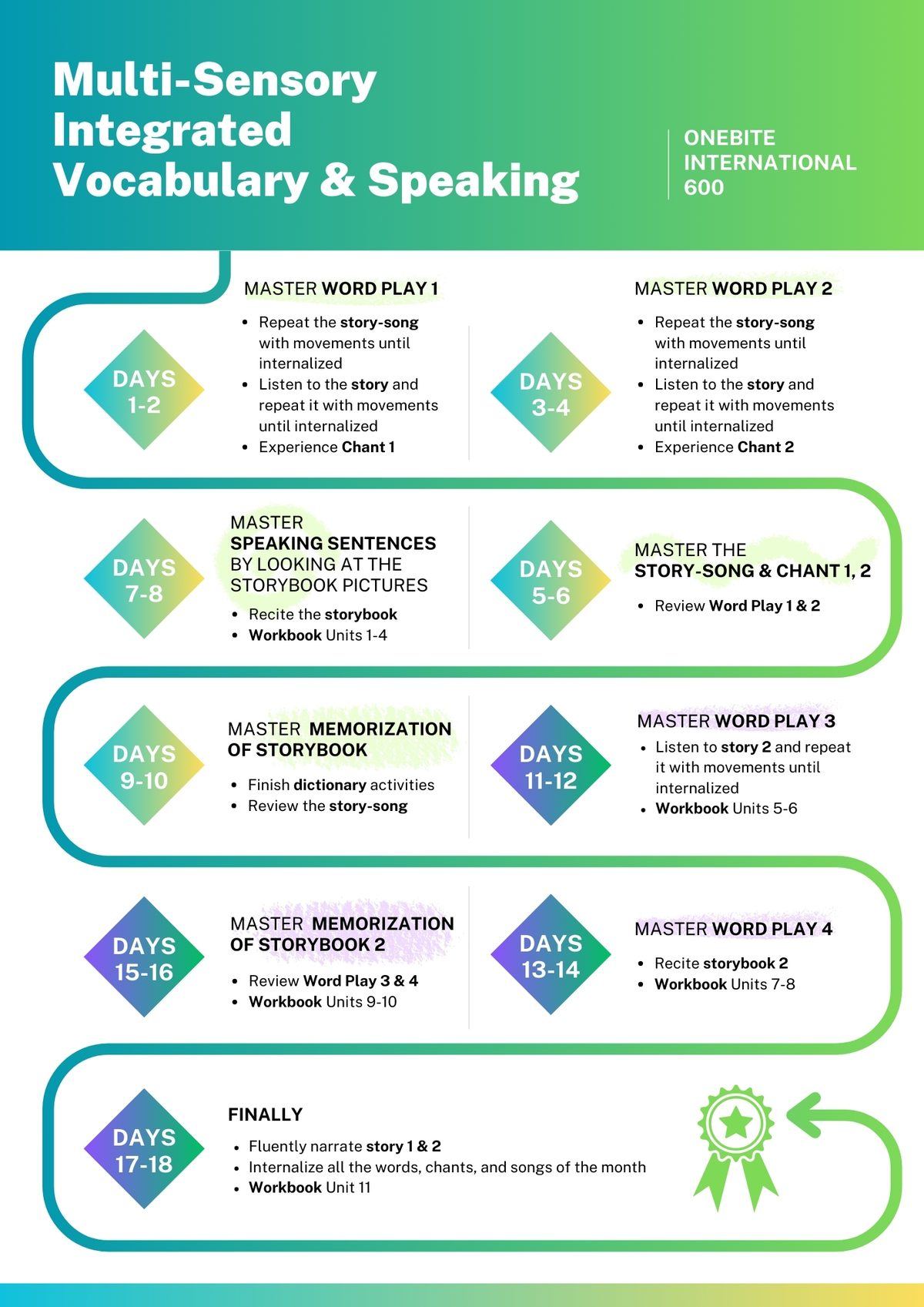
An 18-day winding path. Days 7–8 master speaking the sentences from the storybook pictures → Days 9–10 memorize the storybook → Days 17–18 Finally.
Two stories and four Word Play sets a month. Days 17–18, ‘Finally: fluently narrate both stories.’
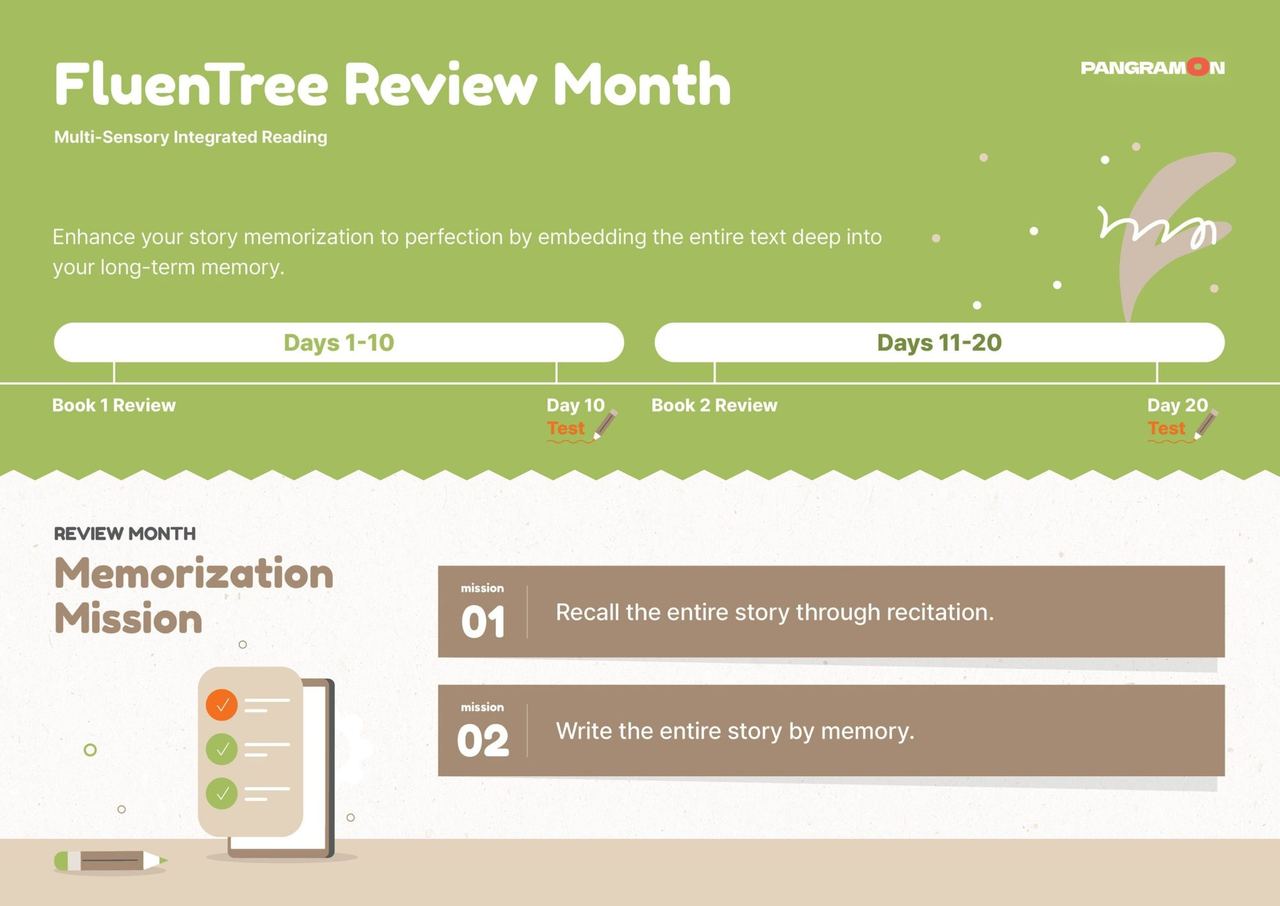
Every other month, two books again. Day 10 test · Day 20 test. The month of review that lifts retention.
“Summarize one book into 20 questions and answers, rebuild it as a structure map, and tell the whole of it without the book.” — what a child does at the end of a PYP Level 1 month.
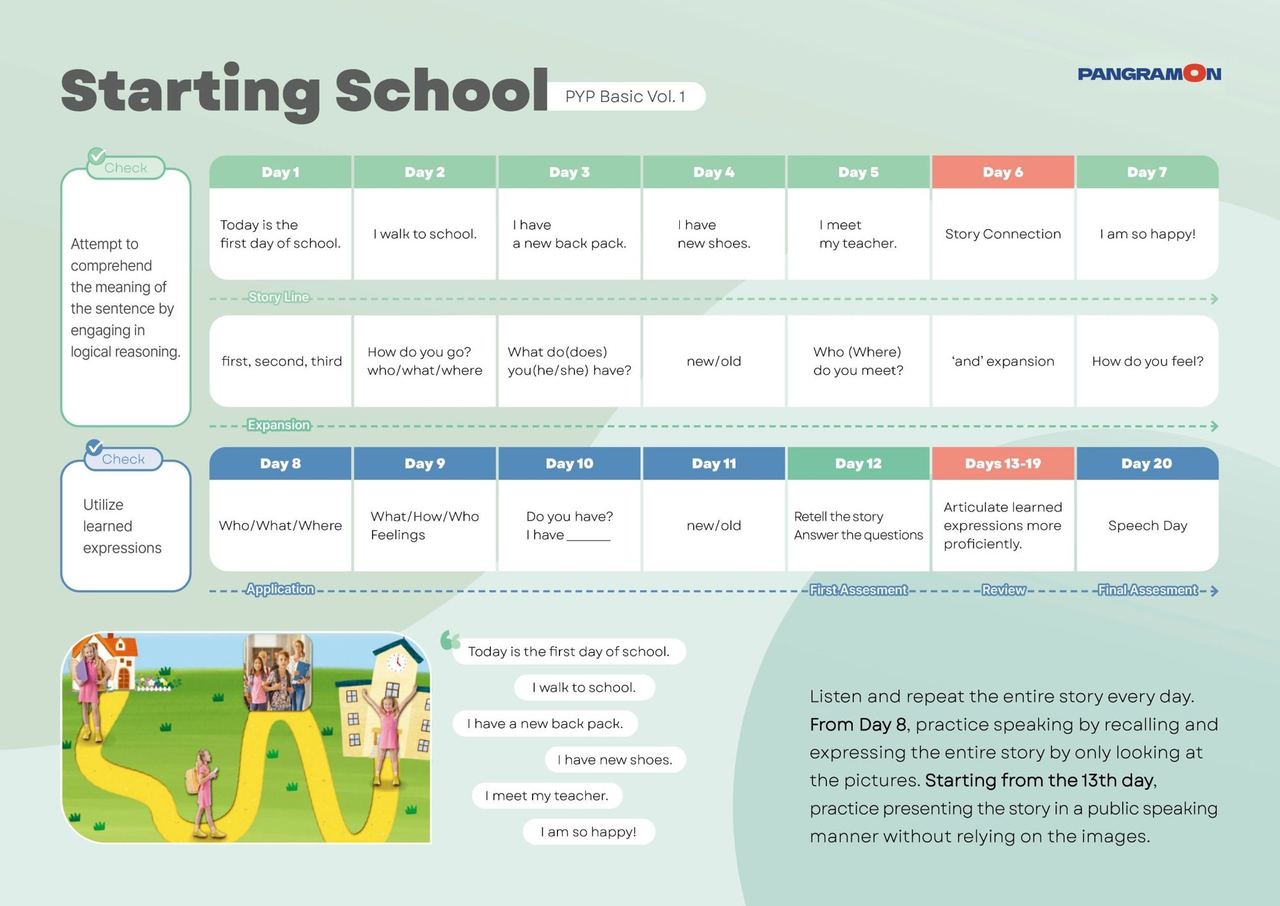
From Day 8 the child tells the whole story from pictures alone; from Day 13, as a public speech without them.
Independent learning
The child knows first whether she has arrived
Every poster carries a self-judgment device. Before the teacher gives a score, the child colors a star, ticks a box, fills a blank. “I can read just like a native speaker.” — a goal on day one, a verdict the child delivers herself on the last.
Two stars — SoundTree Word Path
One star when you start reading the word, two when you really know it. Every sound and sight word a child should read after Core 1, on one sheet.
Two checks — OneBite Word Play
One check for mastering the word with body language, a second for making a new sentence with it. Not a child who retrieves what was memorized, but one who makes something new.
“I can answer all of these questions!” — PYP 20 Questions
For each sub-topic, the child marks whether she can answer all twenty questions.
My Collection — SoundTree Self Summary
The child writes the sounds and sight words she learned in her own hand. The teacher does not make the chart; the child does. At the end of Plus she summarizes four months of learning on one sheet, marking what she is sure of and what needs more practice.
Blank frames — recall boards
The blanks on FluenTree memory boards and OneBite’s Narrate the Story are filled from memory: from speaking with pictures to speaking without them.
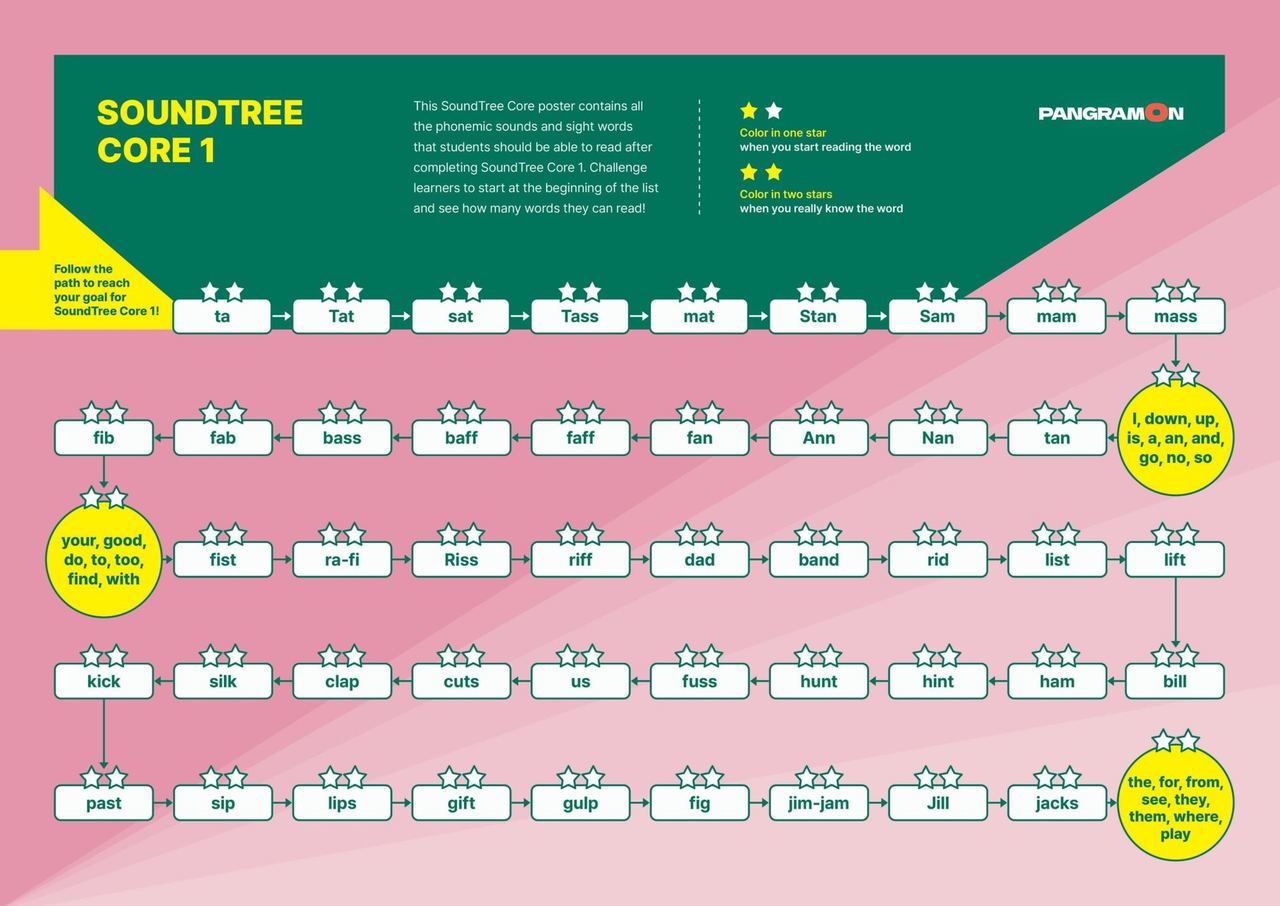
Color in one star when you start reading the word, two stars when you really know the word.
On the wall of a SoundTree Core classroom.
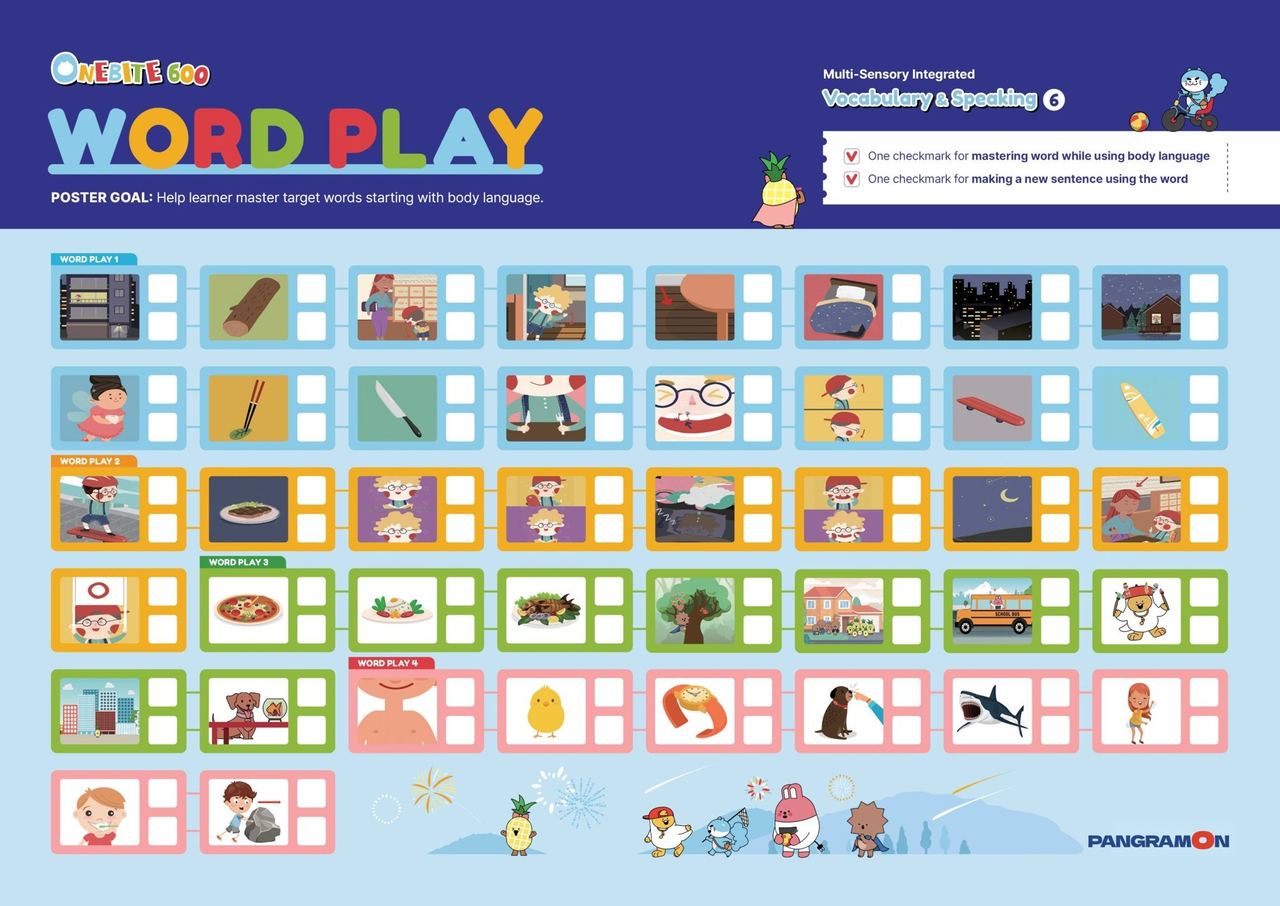
One checkmark for mastering the word with body language, one for making a new sentence.
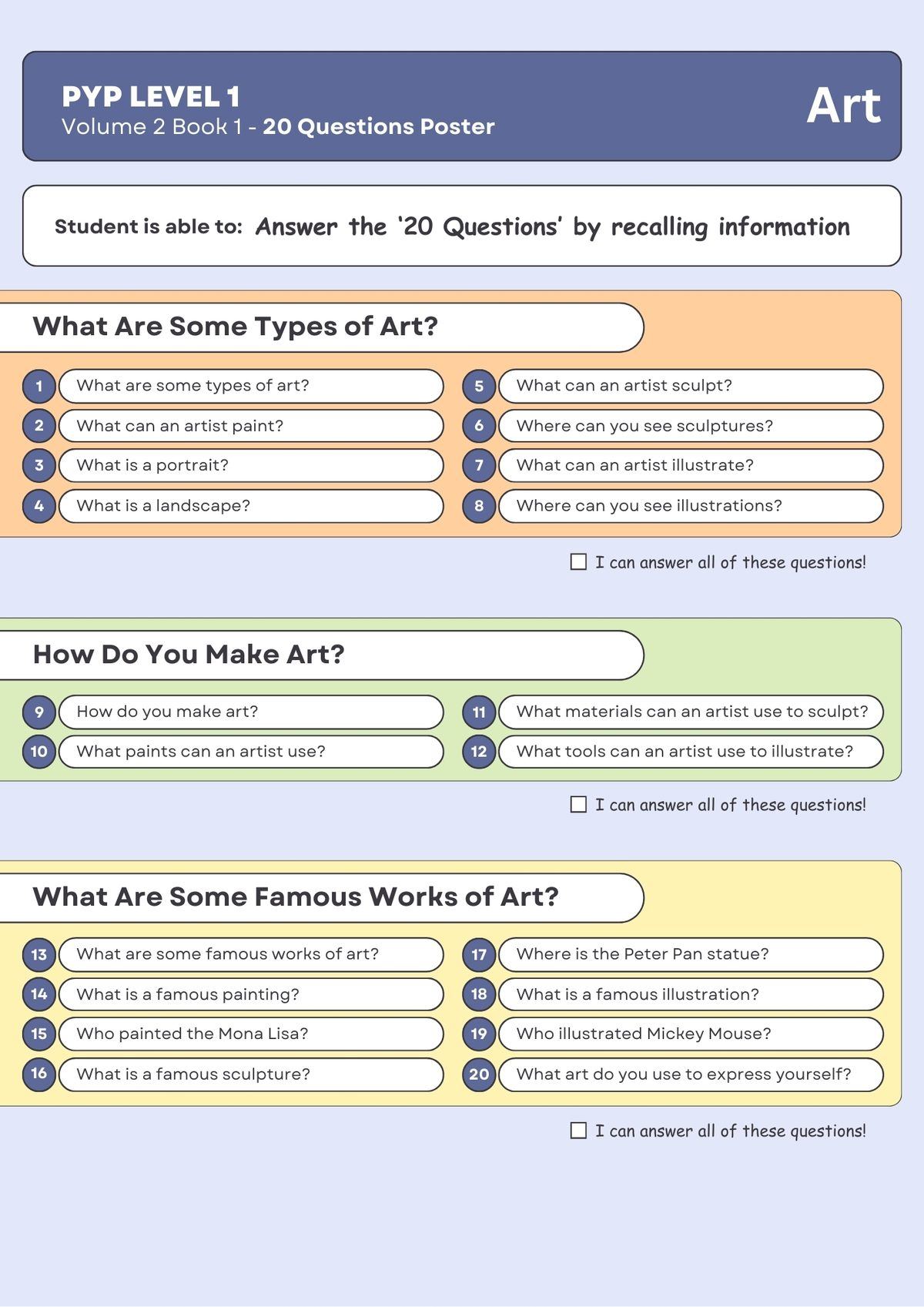
“I can answer all of these questions!”
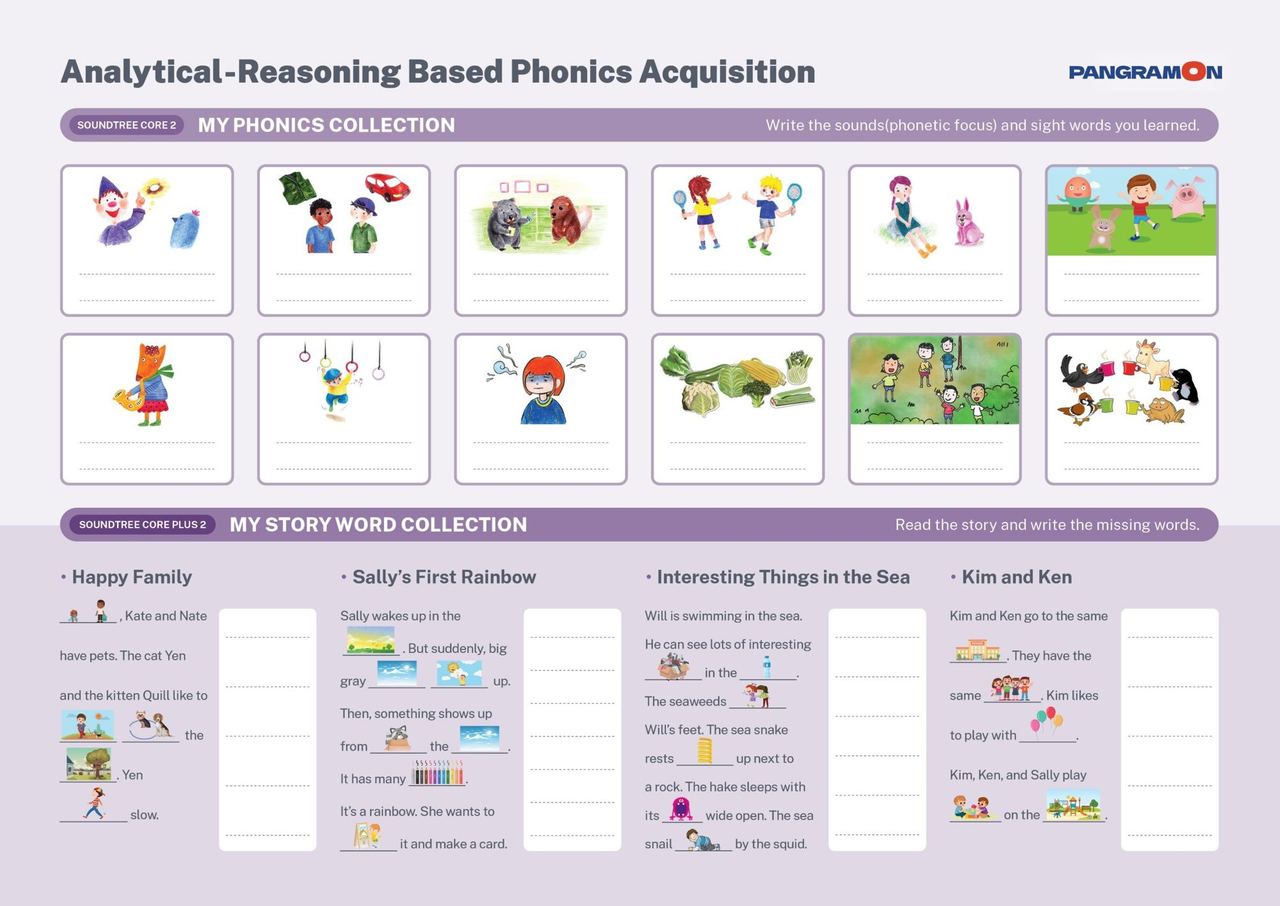
A summary poster the child writes herself.
Ten to fifteen minutes a day, and what to look for
There is not much to do at home: 10–15 minutes of MyGrow a day, reading aloud and recording. The rest the child manages with her diary.
The MyGrow diary
daily · monthly · sometimes. The child notes and checks today’s homework. Five to fifteen minutes depending on level.
A personal online bookshelf
Recorded read-alouds build up. Hearing her own voice from a month ago is enough for a child to see her growth.
What to look for
How your child listens to a sound, what she does in front of a word she has never seen, and what she asks where she got it wrong. Look at these three rather than the number of words read.
Principles to keep at home
Do not write English sounds in Korean letters · do not read a new word for her · answer ‘why?’ with ‘what do you think?’ — keeping the classroom’s principles at home speeds up her discoveries.

Daily perfecting and the diary: the child watches a month of growth herself.
Online perfecting that continues at home — part of the lesson on campus, homework at home.
Self Learning Management — daily · monthly · sometimes diaries.
Self Learning Management. Daily, monthly and occasional diaries build the habit of managing one’s own study.
Progress reports
What goes home every month
PangramOn confirms competence by program goal and reports to parents every month. Different outcomes — recitation and use in a new situation, for instance — are confirmed separately.
Curriculum Details (what was learned this month) · Cognitive Assessment (the focal cognitive abilities) · Achievement Evaluation. One sheet per subject.
Reading Check · Dictation · Speech Day · Memorization Test — each subject’s moment to show on day 20.
LINK tests (★)
A completed subject is confirmed against its core learning goal with a link test in the Learning Boat.
Tier-transition consultation
The next Tier is designed on the premise that the previous Tier’s competence is in place. Any competence still to fill, the check results and the preparation course are explained in consultation.
The cover of the report that goes home every month. Teaching · Coaching · Perfecting.
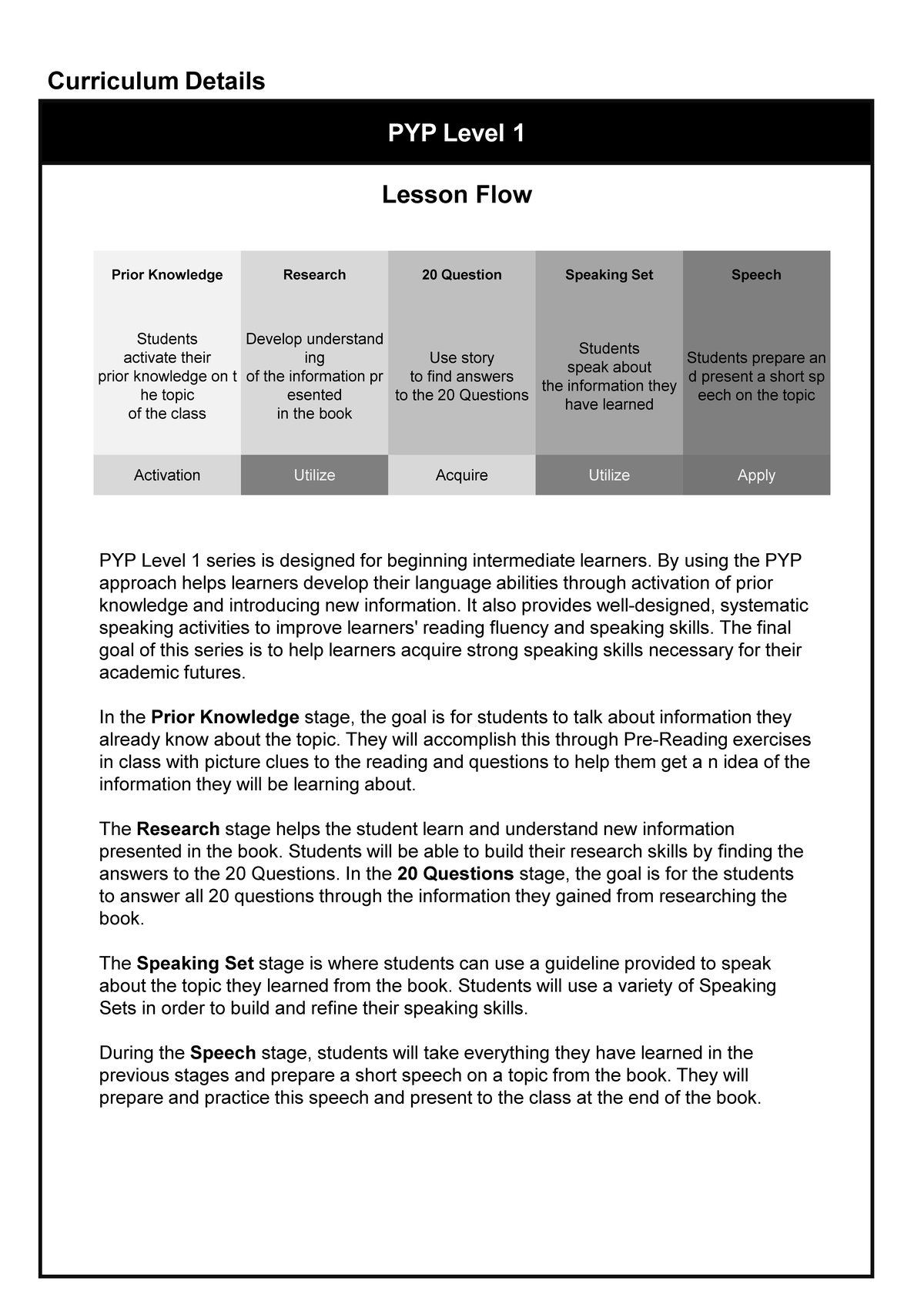
Prior Knowledge → Research → 20 Questions → Speaking Set → Speech: the flow of what was learned this month.
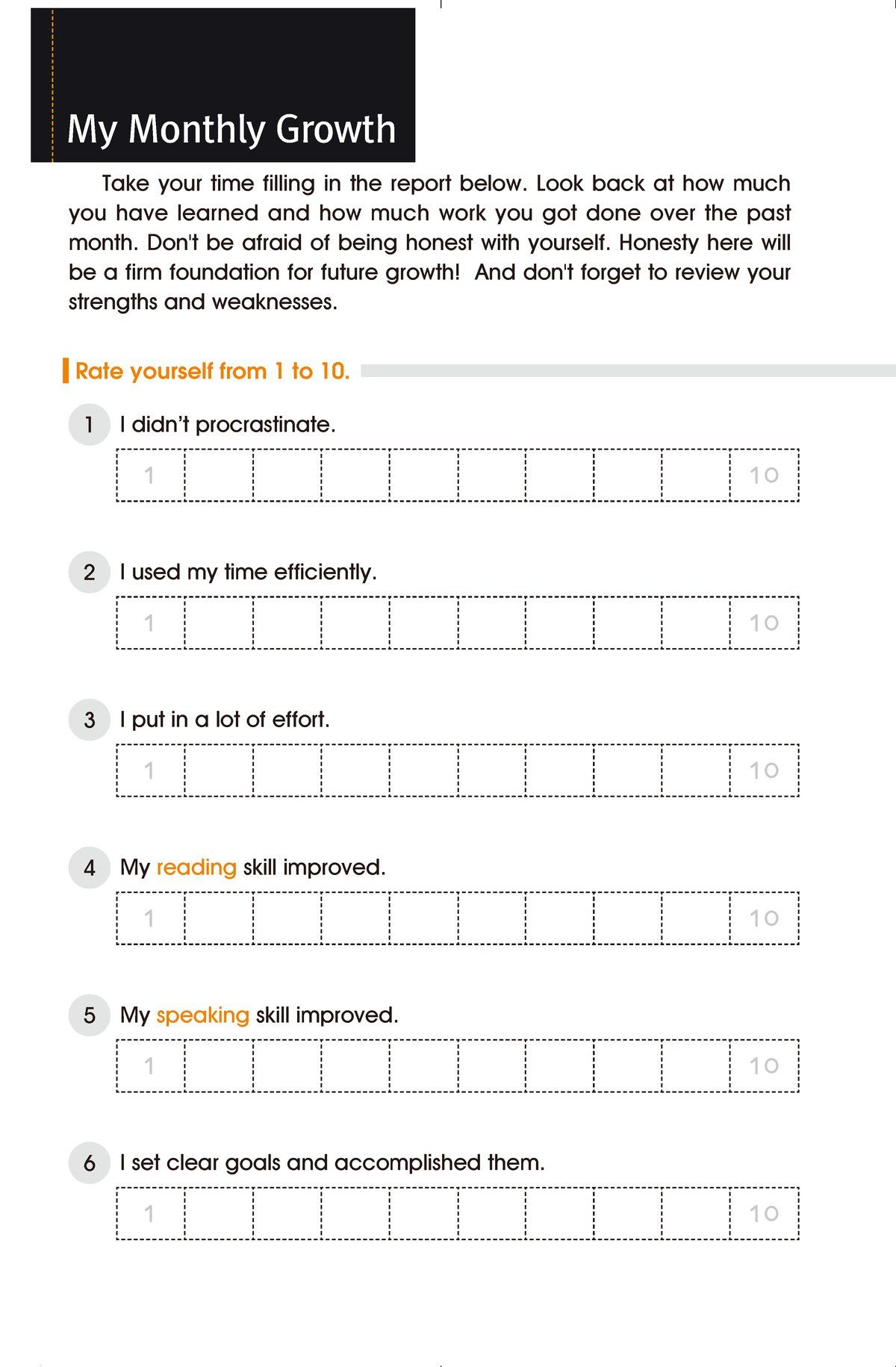
The child rates herself from 1 to 10. “I didn’t procrastinate.” “My reading skill improved.” — self-judgment is a page of the report.
- 4
Excellent
- 3
Meeting expectations
- 2
Showing progress
- 1
Needs encouragement
Learning spaces
Learning Box · Learning Boat · MyGrow
A PangramOn campus is laid out like its learning system. Each subject’s OKR posters and memory boards hang on the classroom walls, so the child always sees the month’s goal and her own progress toward it.

A PYP “Our Community” lesson with a native-speaking teacher. Standardized materials and lesson plans.
A classroom where each subject’s OKR posters and memory boards keep the month’s goal in sight.
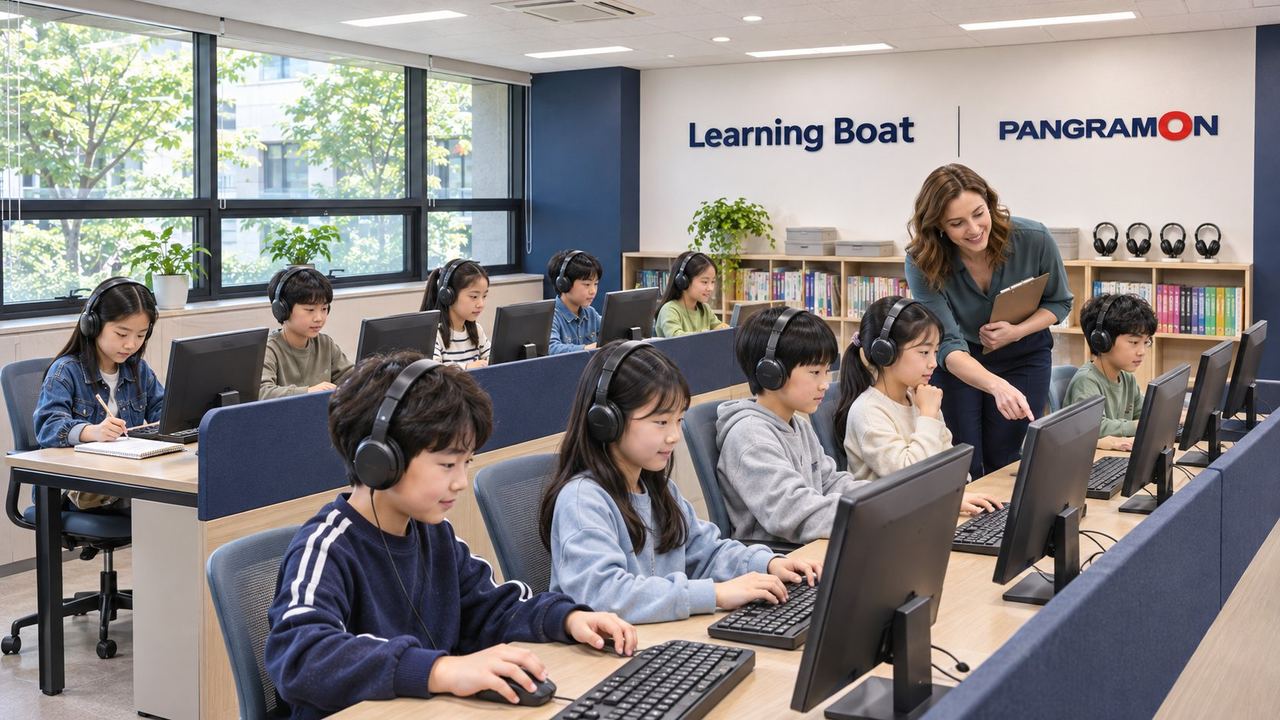
Where the child retrieves what was learned with the learning manager: vocabulary and grammar e-learning, and link tests.
Where entry checks, monthly and quarterly subject tests and link tests take place.

Learning Flow · 20 Questions · Story Structure · Word Path · Word Play · Storybook Memory Board — the wall where a child colors stars, ticks boxes and fills blanks.
Speech Day
One structure map as the only cue, and the whole book told without opening it.
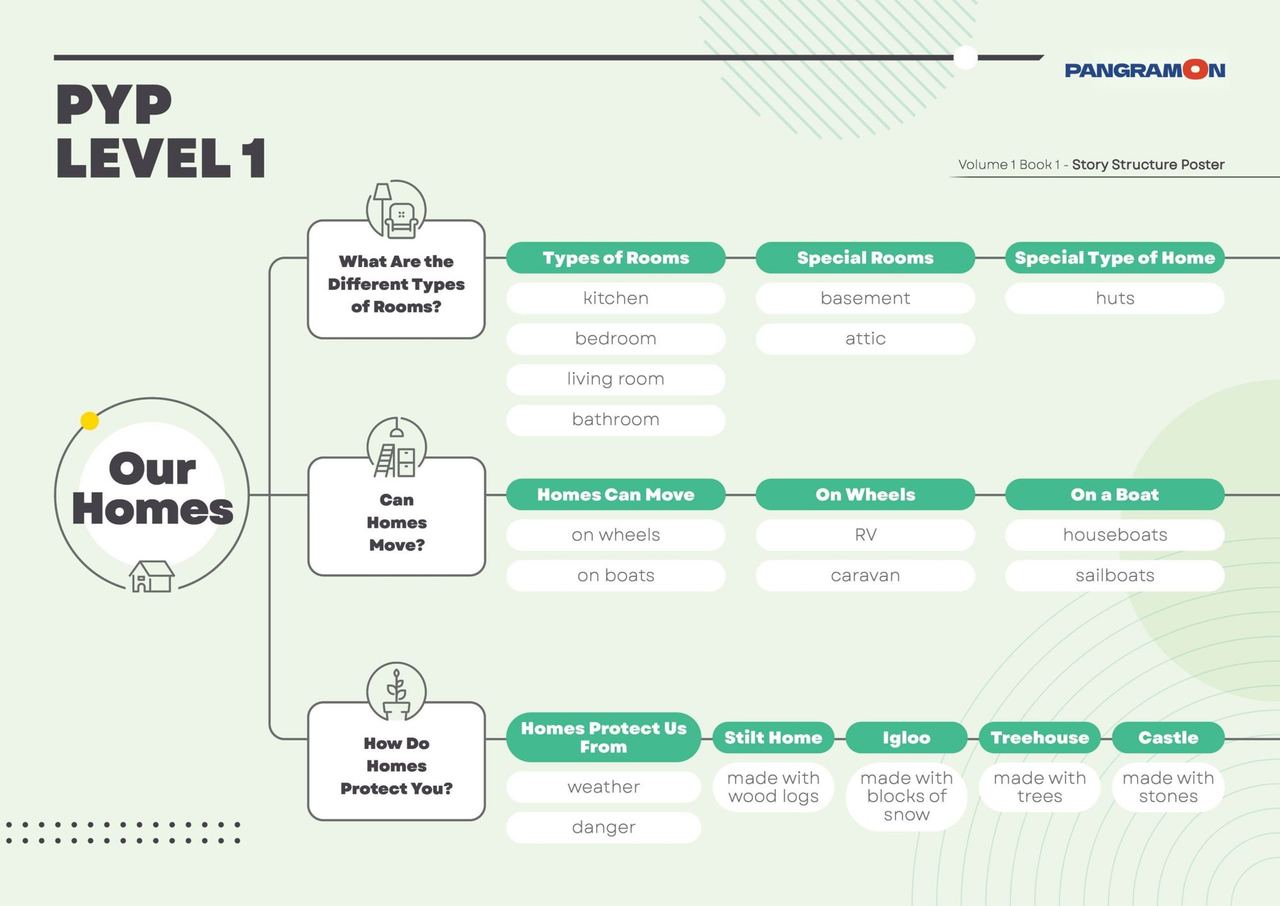
On the wall of a PYP Level 1 classroom.
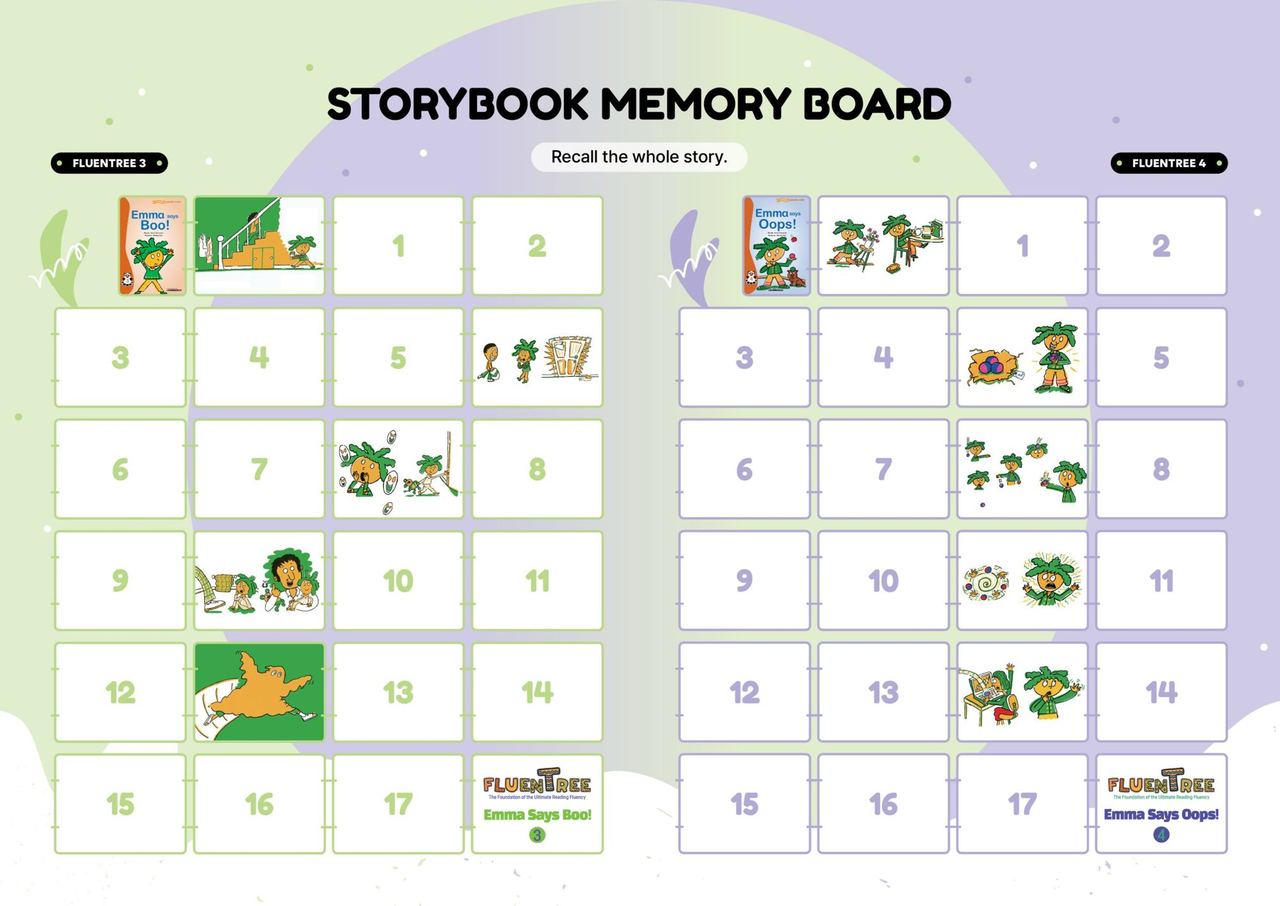
On the wall of a FluenTree classroom.
Every learning journey starts with a conversation
Contact us to learn about the curriculum and a campus near you.