
SoundTree Core
Insight phonics — the right start in English, sound first
Overview
PangramOn’s gifted phonics is realized through the SoundTree Core program. Because a child hears, distinguishes and reproduces sounds, connects them to letters, and discovers the principle of reading for herself while combining letters, we call it ‘phonics acquisition based on analytical reasoning’.
Analytical Reasoning Based Phonics Acquisition
- Day one: three cards, a·s·t. Pick the sound out by ear, make it with the mouth, pair it with the letter — and the child joins them first. “sat.” “tas.” — “That isn’t a word. But you read it.” The child becomes an inventor. In the first week she reads every combination three sounds can make.
- Three ways SoundTree Core is different. ① The order is different — not alphabet, single consonants, short vowels, but the 220 speech sounds in order of frequency in speech. ② The principle is different — not whole-word memorization but attention to sound and self-discovered rules of combination, so the child reads words and sentences she has never seen. ③ The readers are special — written only with the sounds learned so far. After the first lesson on /a/ /s/ /t/, the child reads a story written with those three sounds.
- “Just Coach — the teacher does not read first.” On the third day of every week the child reads that week’s reader, written only with that week’s sounds, alone and for the first time; on the fourth day she reads it exactly like the native speaker and dictates it; on the fifth she reads against a timer. Accuracy comes first; the standard for speed is her own last record. Dictation is the first activity of the lesson — a word that opens in only one direction is a word only half known.
Sound-first insight phonics. Readers written only with the sounds learned so far — and the child reads them first.
Skills & goals
Cognitive abilities trained
Inductive ↔ Deductive Reasoning
From examples of sounds to a principle, and from the principle to new words
Receptive ↔ Productive Cognition
From hearing and distinguishing a sound to producing it precisely
Spoken ↔ Written Proficiency
From spoken to written thinking — reading and dictation in both directions
Learning goals
Accurately read all words by applying knowledge of phonetic patterns and sound-letter correspondences
Transcribe any combination of sounds accurately
Finally — automaticity in reading words. The insight to think of English sounds as a sequence of phonemes, and the automaticity to read a word on sight, are the keys to reading fluency and comprehension
Lessons
Sounds First → Mastering
Sounds First — experience the sounds first, distinguish them, reproduce them, connect sound and letter
Decoding — combine letters and read
Understanding — discover the principle of reading for yourself
Internalization — practice until reading is accurate and fluent (Let’s Practice pages & readers)
Encoding — write the sounds you hear (Listen and Dictate)
Mastering — master the principle of turning letters into sounds and sounds into letters
Core Plus — Decode to Comprehend
In the four-week Plus course after the main course, the child spends a week listening to, reading, dictating and memorizing a picture storybook written only with the sounds and letters learned — and on Friday closes the book and writes the story from beginning to end (Memorize the Story). From phonics reading to reading at the level of sentence comprehension: Story Words (solving unknown sounds with known ones) and Scoop and Read (reading in breath-length chunks).
Materials
Core 1·2·3 + Plus 1·2·3
240 online teaching materials
57 phonics readers
105 sight words · 745 decodable words · 168 meaningful words
396 online components · 200 e-books for perfecting
Monthly Assessment — Reading (M1) · Dictation (M9·M11) · Reading (M12)
OKR posters — 2 goal guides · 3 Self Evaluation · 3 Self Summary
Monthly Progress Report
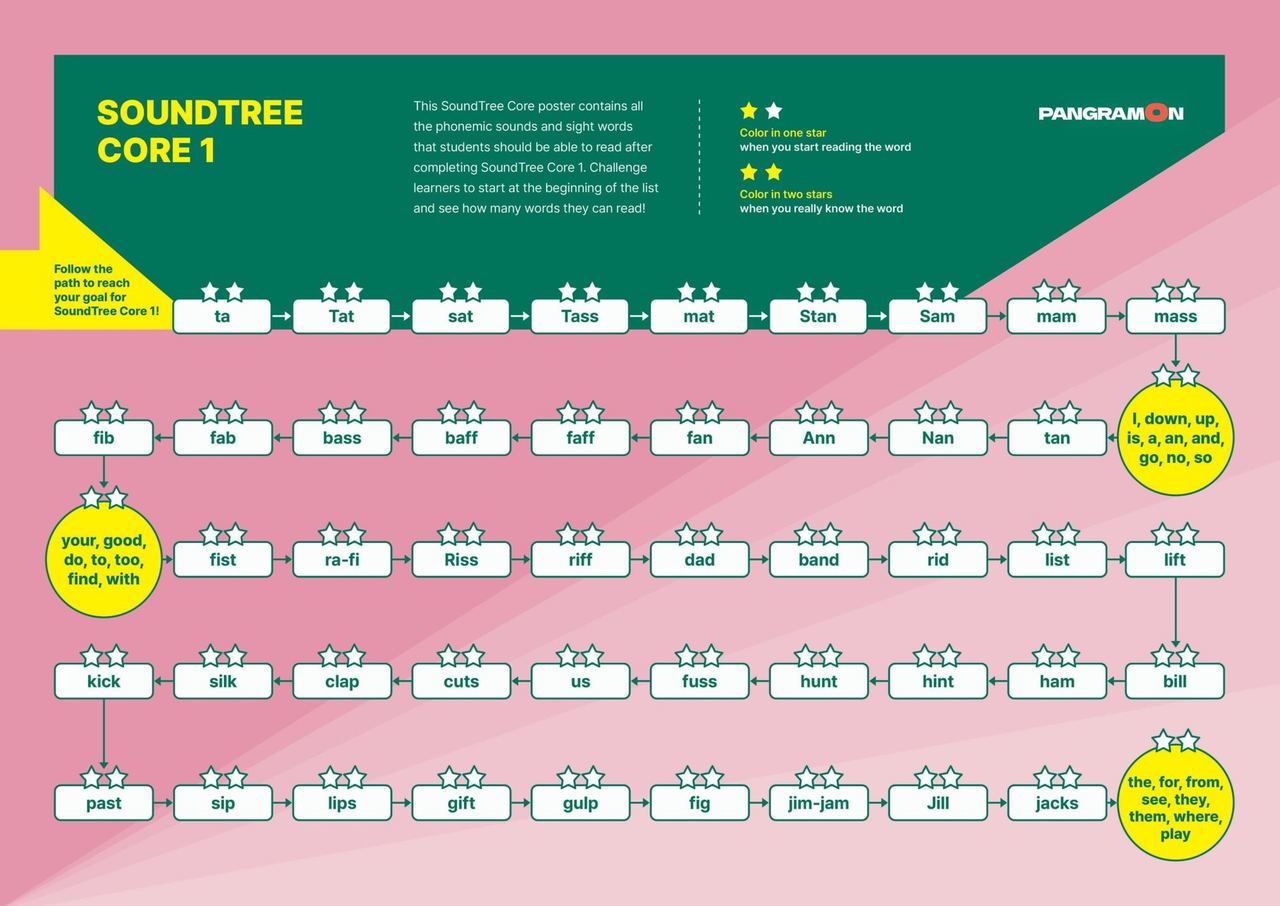
Every sound and sight word a child should read after Core 1. The first line, ta → Tat → sat, is day one’s a·s·t. One star when you start reading the word, two when you really know it.
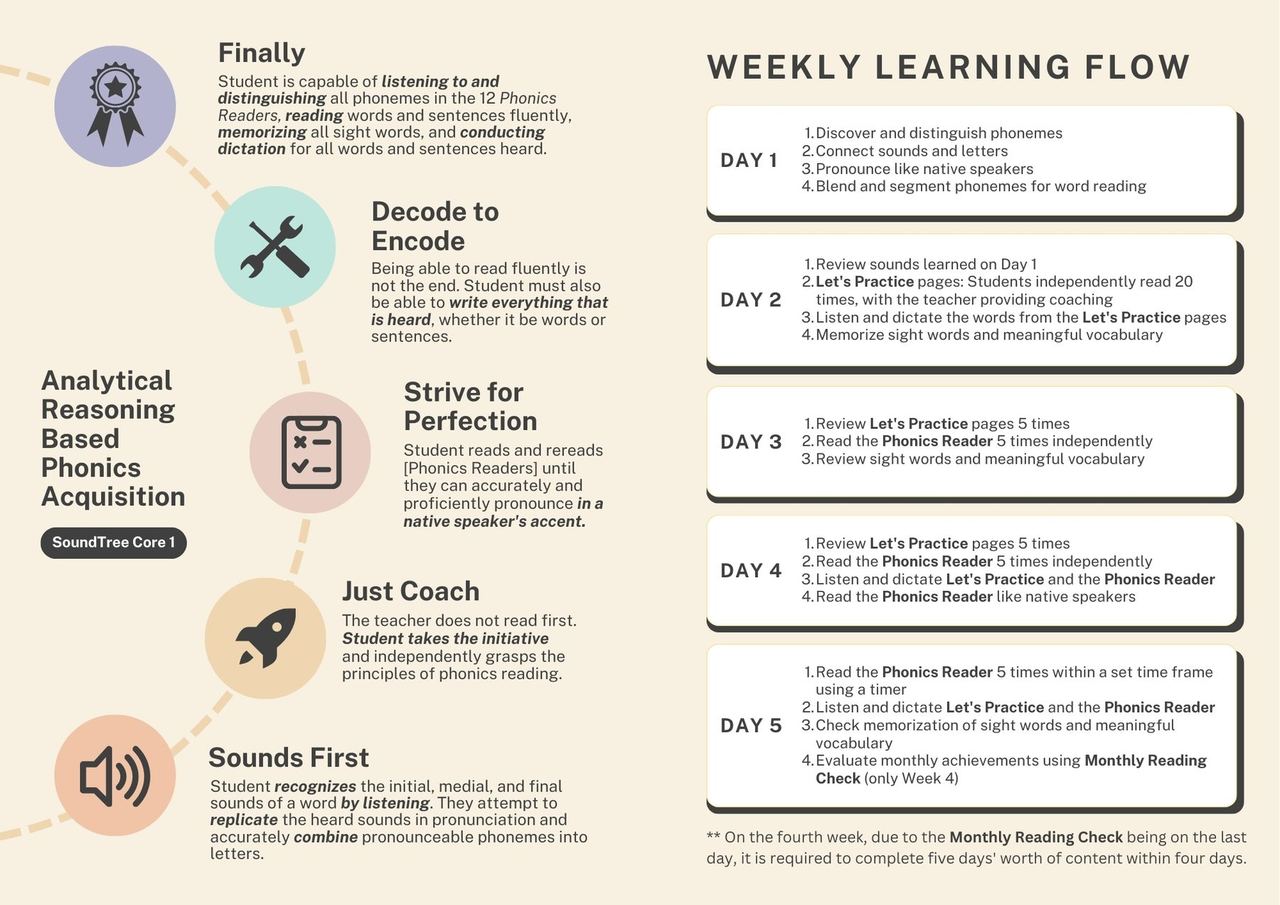
Sounds First → Just Coach (the teacher does not read first) → Strive for Perfection → Decode to Encode → Finally. On the right, the weekly flow for Days 1–5.
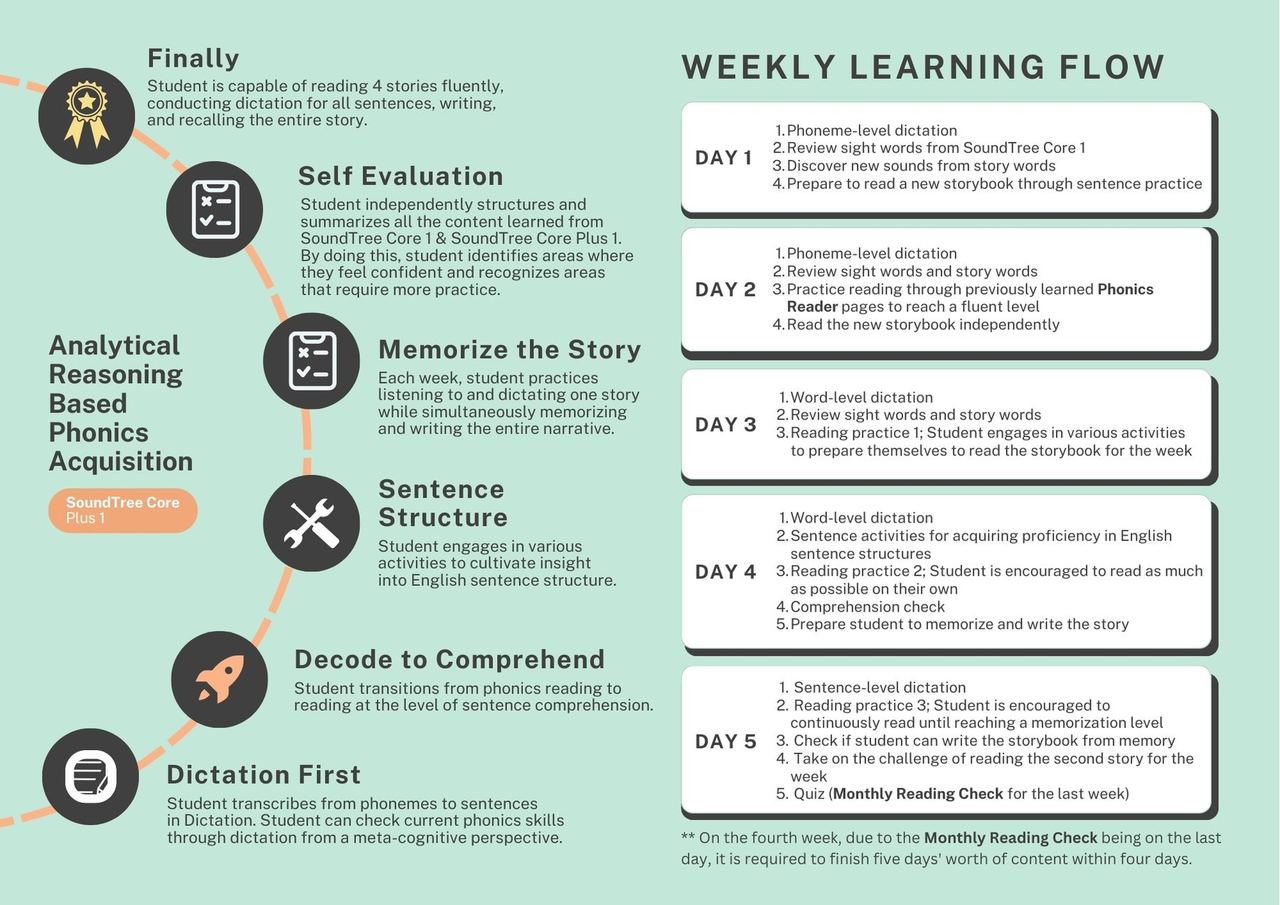
Dictation First → Decode to Comprehend → Sentence Structure → Memorize the Story → Self Evaluation. On Friday, the book is closed and the story written.
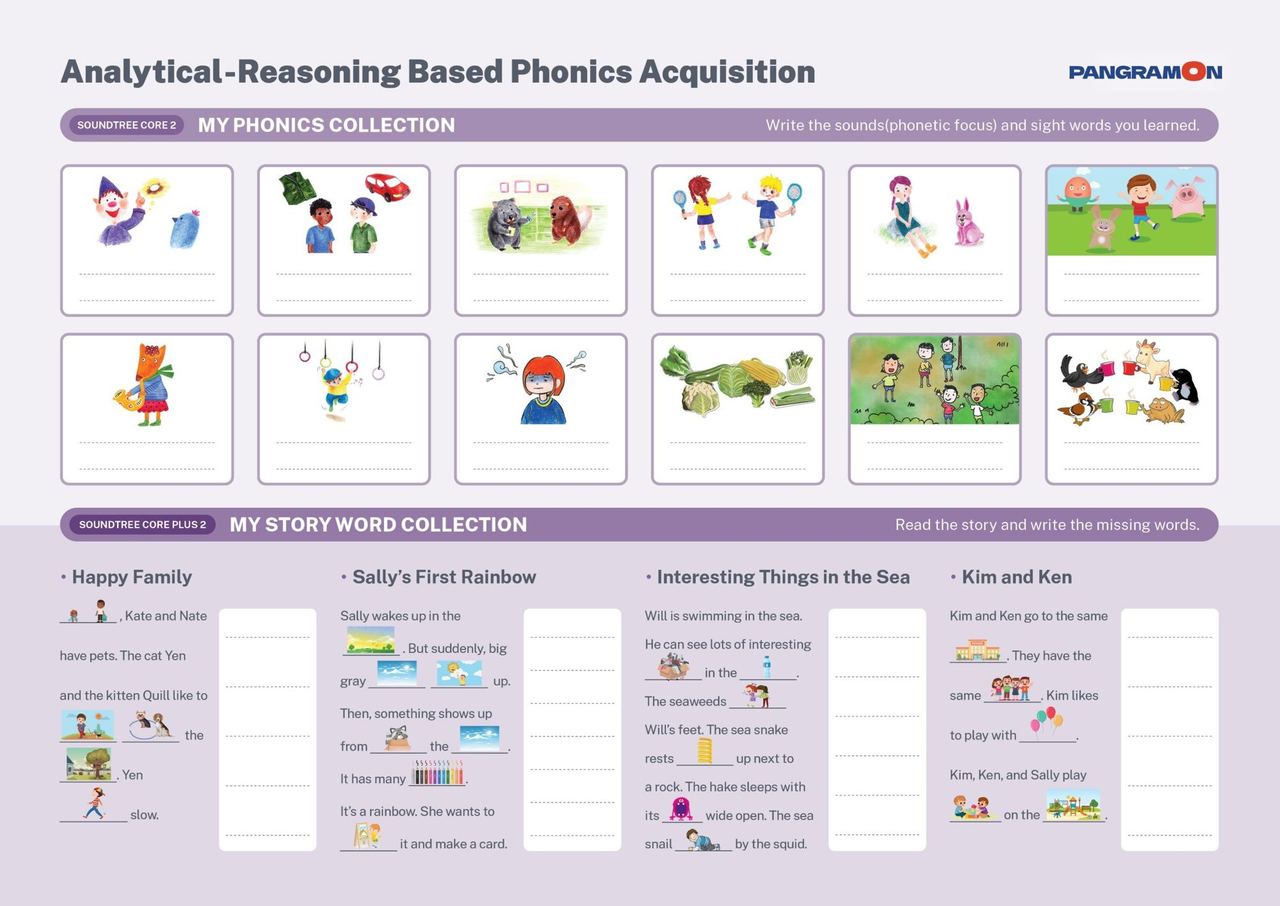
The child writes the sounds and sight words she learned in her own hand. The teacher does not make the chart; the child does.
Every learning journey starts with a conversation
Contact us to learn about the curriculum and a campus near you.